
 EN
EN  English
 русский
 Español
 عربى
عربىCoaxial Semi-Automatic Stripping Machine: Why Precision Matters?
Coaxial cables look simple from the outside. But inside, they have layers. Insulation, shielding, dielectric, conductor. Each layer must be stripped to the exact length and depth. A coaxial semi-automatic stripping machine is built specifically for this job.
Unlike manual strippers that rely on hand steadiness, a coaxial semi-automatic stripping machine uses precision blades and programmable settings. The difference in stripping quality is visible under magnification.
What makes coaxial cable different
Standard wire has one insulation layer over a copper core. Coaxial cable has multiple layers. Outer jacket, braided shield, aluminum foil, dielectric insulator, and the inner conductor.
A coaxial semi-automatic stripping machine must remove each layer separately. The outer jacket comes off at one length. The shield gets cut at another. The dielectric strips back to expose the conductor.
If you use a common stripper on coaxial cable, you will nick the shield or cut into the dielectric. A coaxial semi-automatic stripping machine prevents this by controlling blade depth for each layer independently.
Rotating blade design for clean cuts
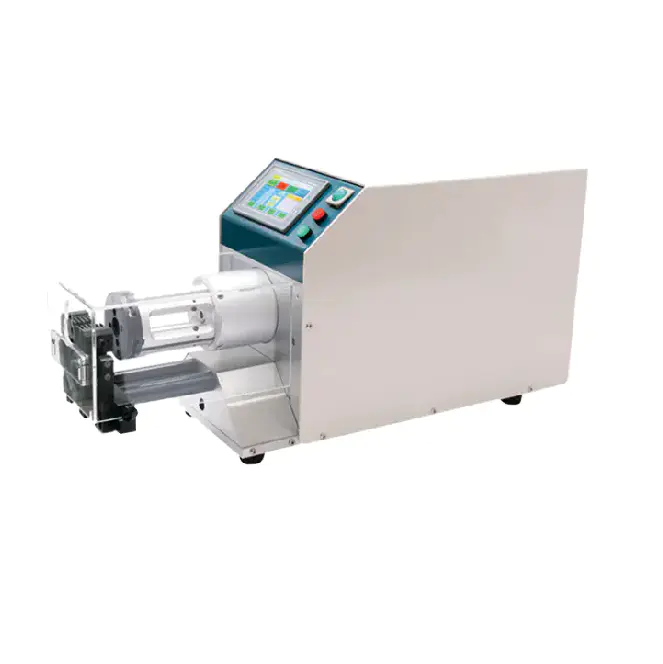
The cutting mechanism on a coaxial semi-automatic stripping machine is different from wire strippers. Instead of pulling blades straight into the cable, the blades rotate around it.
Four high-precision steel blades on a coaxial semi-automatic stripping machine spin 360 degrees around the cable. They cut through each layer with consistent pressure. The resulting cut edge is smooth, not torn or jagged.
For cables with thin foil shields, a coaxial semi-automatic stripping machine makes the difference between a clean strip and a ruined cable. A torn shield degrades signal quality.
Multi-layer programming saves time
A coaxial semi-automatic stripping machine can store stripping programs for different cable types. You set thestrip length and depth for each layer once. Then recall that program whenever you process that cable.
Some coaxial semi-automatic stripping machine models store up to 99 or even 500 programs. For a shop that processes many cable types, this feature is essential.
Without a coaxial semi-automatic stripping machine, workers must measure and adjust for each cable. That takes time and invites errors. With stored programs, the same cable strips perfectly every time.
Cutting accuracy at 0.01mm
The coaxial semi-automatic stripping machine models achieve cutting accuracy of 0.01mm. That is one hundredth of a millimeter. For reference, a human hair is about 0.07mm thick.
This level of precision matters for high-frequency cables. A nick in the dielectric or a scratched conductor changes impedance. Signal reflection occurs. Data transmission suffers.
When you use a coaxial semi-automatic stripping machine with this accuracy, the stripped cable looks factory-made. The conductor is clean and bright. The dielectric cut is square. The shield is intact.
Which industries rely on these machines
coaxial semi-automatic stripping machine users are not casual hobbyists. They are professionals making critical connections.
In telecommunications, techs use a coaxial semi-automatic stripping machine for antenna cables and base station feeders. In medical equipment manufacturing, assemblers use one for patient monitor leads and imaging cables. In automotive, workers use a coaxial semi-automatic stripping machine for backup camera and GPS antenna harnesses.
New energy vehicles also require coaxial semi-automatic stripping machine processing. High-voltage cables and charging station cables have multiple shielding layers that demand precision stripping.
Foot switch and manual button options
A coaxial semi-automatic stripping machine offers different open way. Foot switch keeps both hands free to position the cable. Manual button gives direct control. Top pole touch activation is another option.
For production line work, foot switch operation of the coaxial semi-automatic stripping machine is fastest. The operator inserts the cable, steps on the pedal, and the machine does the cut. Hands never leave the cable.
Blade material affects long-term cost
The blades on a coaxial semi-automatic stripping machine take constant wear. Cutting through copper and aluminum dulls steel over time.
Quality coaxial semi-automatic stripping machine blades use imported steel with titanium alloy coating. The coating reduces friction and extends blade life. Uncoated blades on a cheap coaxial semi-automatic stripping machine will need replacement much sooner.
When comparing coaxial semi-automatic stripping machine prices, factor in blade replacement cost. A machine with better blades costs more upfront but less to maintain.
Automatic detection reduces waste
Some coaxial semi-automatic stripping machine models include wire detection. The machine senses when wire is present and when it runs out.
If the cable supply ends, the coaxial semi-automatic stripping machine stops automatically. This prevents the machine from running empty, which could damage blades. It also alerts the operator to load more cable.
This feature is more common on higher-end coaxial semi-automatic stripping machine units. For continuous production, it saves time and material.
Is semi-automatic worth the cost
A manual coaxial stripper costs very little. But it requires skill and consistency. Each strip is a guess. A coaxial semi-automatic stripping machine costs more but removes the guesswork.
For a shop that processes dozens of coaxial cables per day, a coaxial semi-automatic stripping machine pays for itself quickly. Fewer ruined cables. Faster production. Consistent quality.
For occasional use, a manual tool may suffice. But for any professional setting where coaxial cable is a daily job, the coaxial semi-automatic stripping machine is the right tool. Precision, repeatability, and speed all justify the investment.