
 EN
EN  English
 русский
 Español
 عربى
عربىHow Coaxial Semi-Automatic Strippers Hold Cutting Accuracy?
A stripping accuracy figure of 0.01mm printed on a spec sheet means little to buyers unless they understand what keeps that tolerance stable across thousands of production cycles rather than just on a fresh, unworn blade. Manufacturing a Coaxial Semi-Automatic Stripping Machine that holds tight cutting accuracy over its full service life depends on blade geometry, material selection, and drive precision working together, not a single specification in isolation.
Rotating Blade Geometry Determines Cut Consistency
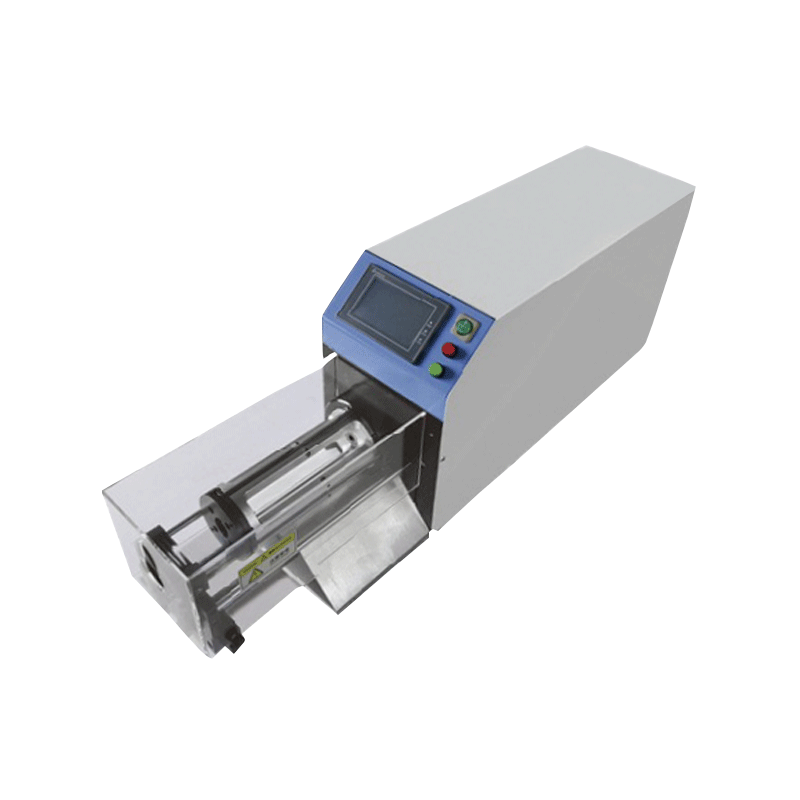
The four-blade rotating design used in a Coaxial Semi-Automatic Stripping Machine performs a 360-degree circular cut around the cable, and the precision with which those blades are machined and aligned during assembly directly determines whether the cut edge stays smooth without damaging the inner conductor or shielding layer underneath. A rotating blade wire stripper built with blades machined to inconsistent angles will produce cuts that look acceptable on a sample but degrade in consistency across a full production batch, which is why manufacturing teams test blade alignment at multiple points during assembly rather than relying on a single post-assembly check.
Multi-Layer Stripping Requires Independent Depth Control at Each Layer
A Coaxial Semi-Automatic Stripping Machine capable of stripping cable down through nine or ten layers needs each layer's length and depth to be set and held independently, since outer insulation, braided shielding, and core wire layers all require different cutting depths to avoid damaging the layer underneath. Manufacturing this capability requires precision control components that hold their calibration across repeated cycles, since a depth-control mechanism that drifts even slightly between layers can damage shielding on one production run while leaving it intact on the next.
Comparing Blade Material and Drive Component Choices
|
Manufacturing Factor |
Standard Blade Steel |
Titanium-Coated Blade |
|
Wear resistance |
Lower, shorter service interval |
Higher, extended service interval |
|
Cutting accuracy retention |
Degrades faster over cycles |
Holds tolerance longer |
|
Maintenance frequency |
More frequent blade replacement |
Reduced replacement frequency |
|
Typical buyer priority |
Lower upfront cost |
Lower total cost of ownership |
These material choices apply across the full Coaxial Semi-Automatic Stripping Machine product range, and buyers should confirm which blade grade a specific quoted unit actually uses rather than assuming the higher-end option is standard.
Program Storage Architecture Supports Consistent Repeat Production
A program storage stripping machine design lets operators save multiple processing programs — some models support up to several hundred sets — and recall preset parameters with a single selection rather than manually re-entering peeling length, layer count, and blade pressure for every wire change. Manufacturing this reliably requires firmware and control hardware that store parameter sets without drift or corruption over years of Coaxial Semi-Automatic Stripping Machine operation, since a stored program that shifts even slightly from its original calibration defeats the purpose of eliminating manual re-debugging between wire changes.
Servo Motor and Bearing Precision Set the Ceiling on Motion Accuracy
Manufacturing a Coaxial Semi-Automatic Stripping Machine to hold motion accuracy within a tight range depends on the quality of ball bearings and servo motor components used in the drive system, since these components directly determine how consistently the cutting mechanism repeats its motion cycle after cycle. Production lines using higher-grade bearings and servo drives achieve tighter long-term stability than lines built around lower-cost generic components, and buyers comparing suppliers should ask specifically about bearing and motor specifications rather than relying on cutting accuracy figures alone, since accuracy on a new machine doesn't guarantee accuracy after months of continuous operation.
Certification and Bulk Supply Considerations
Buyers importing a tungsten steel blade stripper for automotive, medical, or communications cable processing should request certification documentation confirming compliance with relevant safety and quality standards for their destination market, along with production capacity information if the order requires consistent output across a large batch. Manufacturers running dedicated production lines for this category can typically accommodate custom program presets and blade configurations for buyers with cable specifications outside standard offerings, provided the modification stays within the mechanical range the existing tooling supports.